From Developer to Orchestrator: What I Learned by Treating AI Agents Like a Team
April 2026
The interesting shift is not that AI can write code.
It is that it can behave like a team, even when there is only one person involved.
I ran into this while building a related posts sidebar for blog pages. The goal was simple. The outcome was not. What started as a straightforward feature turned into an experiment in how multiple agents can work together, and more importantly, how to coordinate them.
The Problem I Was Running Into
I started the way most people do.
One prompt. One agent. End to end feature delivery.
It looked efficient. It was not.
The agent would:
- design the architecture
- plan the implementation
- write the code
- make assumptions about content and indexing
All in one pass.
The result was familiar:
- layout decisions baked into logic
- incorrect assumptions about metadata
- mismatches between authored content and indexed data
- debugging happening in code instead of the system
It felt fast, but every iteration required going back and undoing earlier decisions.
The Experiment
Instead of trying to improve the prompts, I changed the model.
I treated the agents as separate roles.
This was not about scaling a team. It was about understanding how specialization changes outcomes, even when everything is driven by a single person.
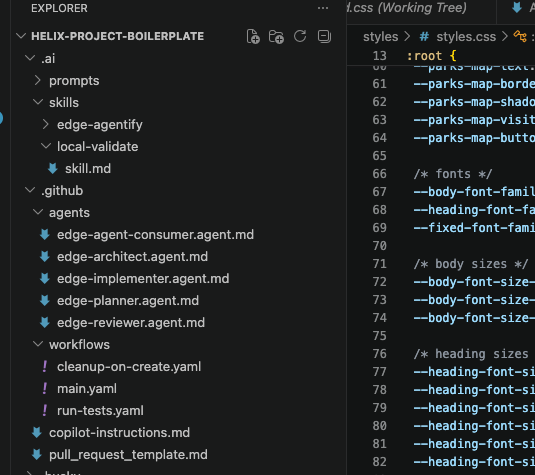
The flow became:
- Architecture agent
- Planning agent
- Implementation agent
- Consumer agent
- Reviewer agent
Each step had a clear boundary. No overlap. No shortcuts.
How the Agents Actually Worked Together
Architecture agent defines the system
This agent did not write code.
It focused on:
- page structure
- authored content contract
- metadata and indexing behavior
For the related posts feature, this meant:
- using a blog-post template for layout
- introducing a related-posts block
- relying on tags via query-index.json
This step forced clarity before anything else happened.
Planning agent makes it executable
The planning agent translated ideas into:
- exact file changes
- required data fields
- validation steps
This is where most of the hidden complexity showed up:
- handling no tags
- handling no matches
- excluding the current page
Catching this here meant it never became a debugging problem later.
Implementation agent just executes
By the time I got here, there was nothing left to figure out.
The implementation became:
- predictable
- minimal
- aligned with EDS
The agent was not making decisions. It was applying them.
Consumer agent checks clarity
This step was not about code.
It looked at the feature as:
- a reader
- a content author
- an AI consumer
This exposed things I would not have caught otherwise:
- unclear headings
- weak relationships between content
- confusing empty states
Reviewer agent checks risk
The final pass focused on:
- bugs
- regressions
- indexing assumptions
This is where I validated the system, not just the feature.
What Changed
The biggest change was not speed.
It was how much rework disappeared.
Before
- implement
- realize assumptions were wrong
- debug
- rewrite
After
- define
- plan
- implement once
- validate
The Role Shift
This is where the model clicked for me.
I was not acting like a developer anymore.
I was acting more like a coordinator.
Defining:
- roles
- sequence
- expectations
Letting the agents handle:
- architecture thinking
- planning
- implementation
- validation
It started to feel very similar to running a Scrum team, except the entire team was AI driven.
Why This Matters
Each agent is good at a specific type of thinking.
None of them are good at everything at once.
By separating responsibilities:
- assumptions surface earlier
- decisions become explicit
- implementation becomes cleaner
And most importantly:
the system becomes predictable.
Takeaway
This was not about building a feature.
It was about understanding how to structure AI work.
If everything runs through one agent, it behaves like a single developer under pressure.
If the work is split into roles, it behaves like a coordinated team.
Even if that team is just one person orchestrating multiple agents.